Mindful Coloring: How Filling in Colors Brings You Into the Present Moment
“I tried meditation, but I couldn’t stop thinking.” This is one of the most common things people say when they describe giving up on mindfulness practice. Sitting still with eyes closed, trying to think about nothing — for many people, that’s harder than it sounds. Thoughts keep rushing in, and the harder you try to clear your mind, the louder everything gets.
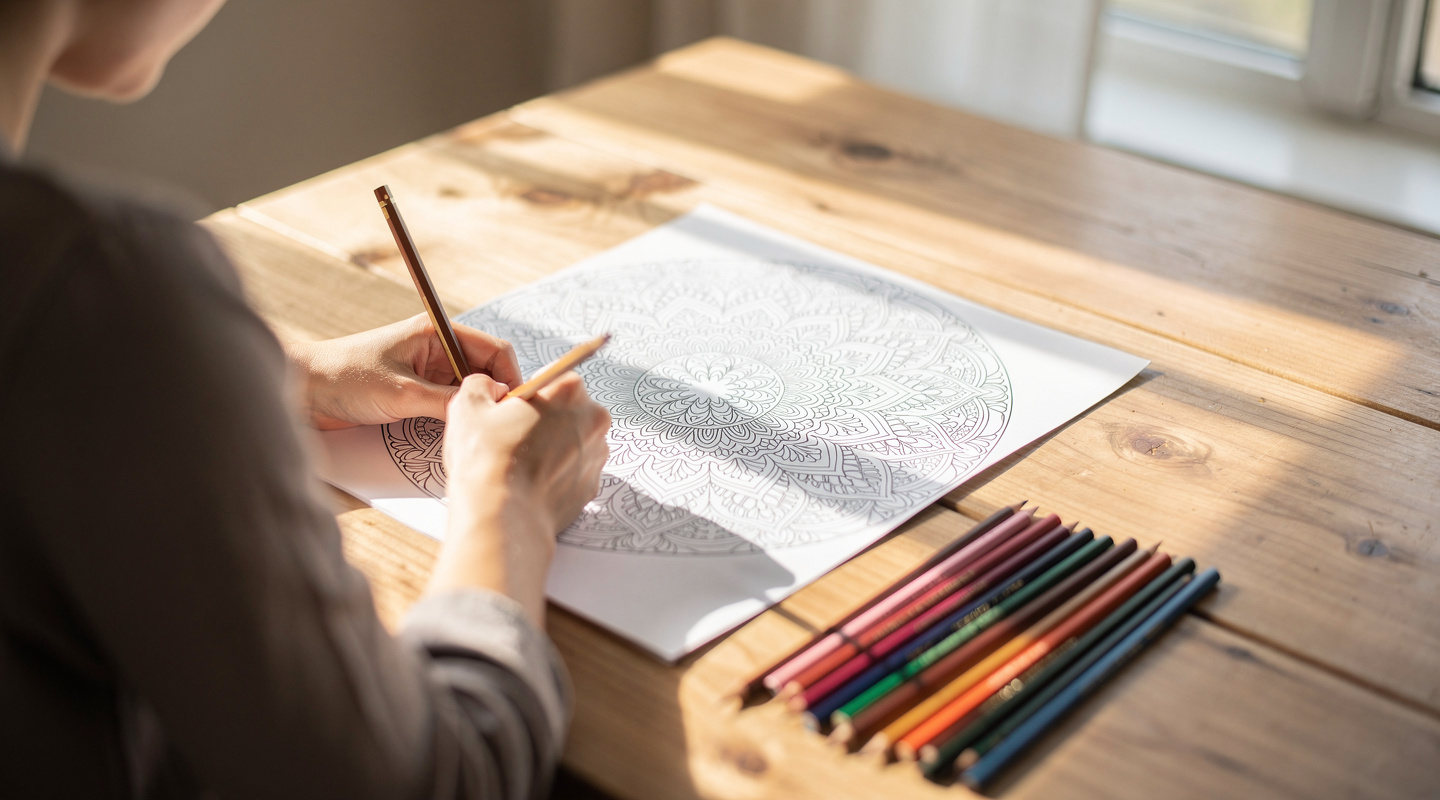
Here’s something that might help: you don’t have to sit still to be mindful. Coloring — yes, the kind with pencils and a page — is one of the most accessible forms of active mindfulness there is. Many people find it easier to be present when their hands are engaged. And the science backs this up.

Yuki

Shio
What Is Mindfulness, Really?
Mindfulness means bringing your full attention to the present moment — what you’re doing, what you’re sensing, what’s happening right now — without judgment. It’s about stepping out of the mental loop of past regrets and future worries, and simply being here.
The concept comes from Buddhist meditation traditions, but was popularized in medical settings in the 1970s by Dr. Jon Kabat-Zinn. Since then, research has consistently shown that regular mindfulness practice reduces stress, improves sleep quality, sharpens attention, and helps manage anxiety. The good news: you don’t need to meditate in the traditional sense to experience these benefits.
Why Coloring Works as Mindfulness
When you’re coloring, your attention naturally settles on the task in front of you: staying inside the lines, choosing what color comes next, noticing how the pencil feels against the paper. There’s no room in that focused state for yesterday’s arguments or tomorrow’s appointments. You’re just here, doing this.
Cooking, knitting, and pottery are often cited for the same reason — any repetitive, hand-based activity that requires gentle concentration can serve as a form of moving meditation. Among these, coloring stands out for its accessibility: no kitchen, no yarn, no kiln required. Just a table and a few pencils.
How Choosing Colors Shuts Out Distraction
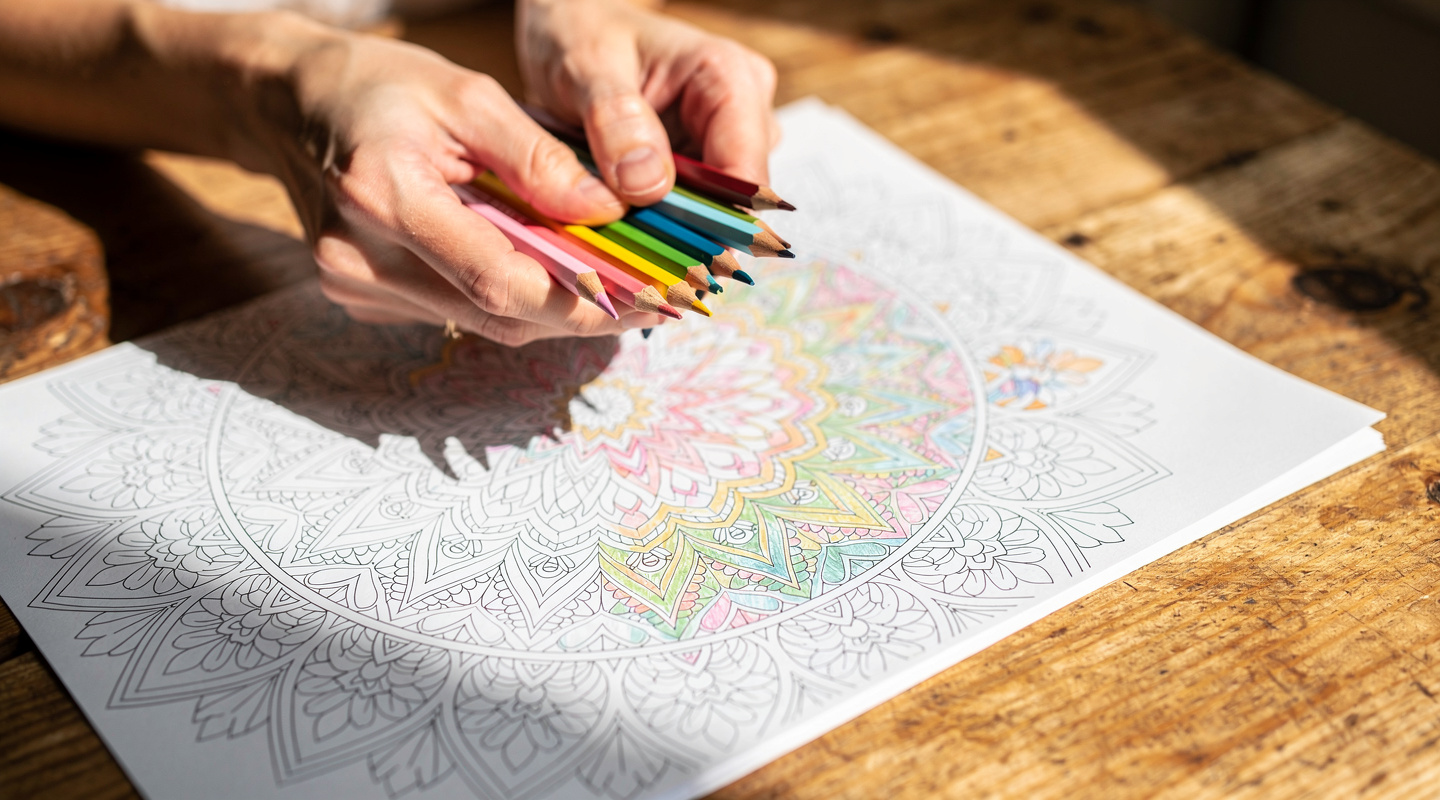
Every time you pause to decide which color to use next, your brain briefly but completely occupies itself with that decision. Blue or purple for this petal? Warm or cool for this section? In those moments, there’s no mental bandwidth left for anything else.
Try it: pick up a set of pencils and look at a coloring page. Notice how your mind starts engaging with the image — considering possibilities, making small creative decisions. That engagement is already a form of presence.
Yuki
Shio
The Brain Science: Why Focus Calms You Down
When you’re deeply focused on a visual, manual task, your prefrontal cortex — responsible for attention, planning, and rational thought — is highly active. As a result, the amygdala (the brain’s alarm system, which drives anxiety and emotional reactivity) becomes relatively quieter. Focused attention is a natural calming mechanism, and coloring is one of the gentler ways to trigger it.
Four Tips to Deepen Your Coloring Mindfulness
- Put your phone in another room: Every notification pulls you out of the present. Even 30 minutes of distance from your phone changes the quality of your focus significantly
- Start without music (at first): Silence amplifies your awareness of the moment. Once you’ve established the habit, soft instrumental music or nature sounds can work well — but lyrics tend to pull attention away
- Notice the physical sensations: How does the pencil feel in your hand? How does pressure change the depth of color? Paying attention to these small details deepens the mindful experience
- Let go of completion: The goal isn’t to finish the page. It’s to be present while you’re on it. Stop when you feel like stopping — that’s listening to yourself, not quitting
Which Themes Support Mindfulness Best?
Repetitive, pattern-based designs tend to draw people into the deepest states of focus. Mandalas are perhaps the most famous example — their radial symmetry and intricate repeating elements create a meditative rhythm as you work through them. Floral patterns, geometric grids, and natural textures like leaves and water work similarly.
Complex narrative scenes with lots of characters require more conscious decision-making, which can interrupt the flow state. Start with simpler, more repetitive designs and see how long you can stay absorbed.
Ten Minutes a Day Can Change How You Feel
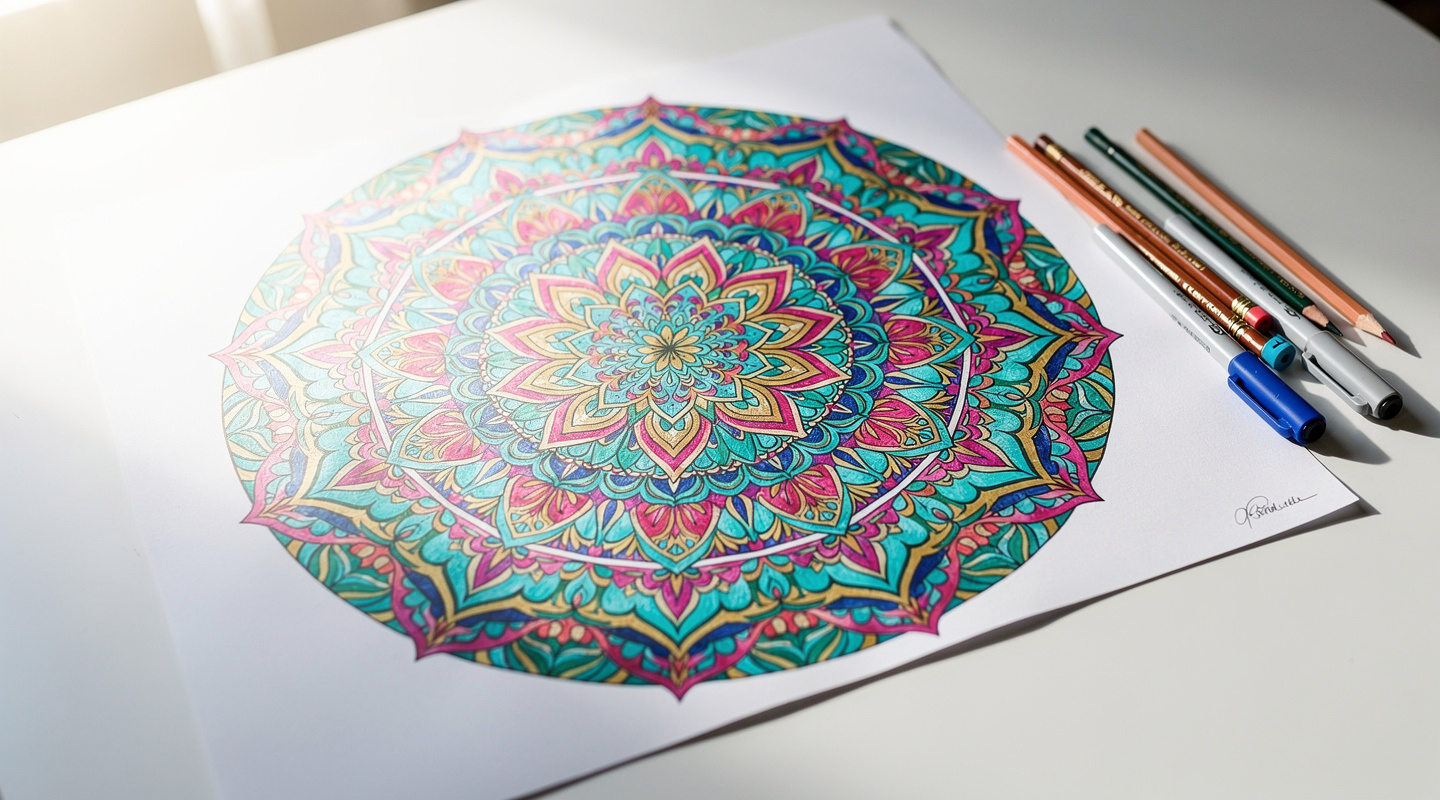
You don’t need a long session to benefit from mindful coloring. Ten to fifteen minutes in the evening — after dinner, before bed — is enough to shift your nervous system from activated to calm. Over time, the simple act of sitting down with your coloring materials can begin to trigger relaxation almost immediately.
What colors do you find yourself drawn to today? Starting with a color you love is an easy way to enter the experience gently. There’s no wrong answer — whatever calls to you is exactly right.

Yuki
Shio
IROTSUNA: A Fresh Page Every Time You Sit Down
One of the keys to a mindful coloring practice is always having something new to engage with. Returning to the same image means part of your brain is operating on memory — rather than meeting the moment fresh.
IROTSUNA solves this with AI-generated coloring pages. Describe any theme — “a lotus floating on a still pond,” “a forest in early morning mist,” “the moon above a quiet village” — and a brand-new line drawing appears in about 30 seconds. Every session starts with something you’ve never seen before. Download free on the App Store.