
Coloring Before Bed: Why It Helps You Sleep Better
What Do You Do on Nights When Sleep Won’t Come?
You’ve gotten into bed, but your mind won’t settle. Sound familiar? You lie there while the events of the day keep circling through your head — and before you know it, your hand has reached for your phone. For many people in their 60s and 70s, the effortless sleep of earlier years can feel harder to come by than it used to.
Poor sleep touches everything: energy, mood, even your appetite for the things you love. “If only I could sleep soundly, my whole day would feel different” — it’s a feeling many people know well. So what can you do with those pre-bedtime hours to gently guide yourself toward rest?
One answer, perhaps surprising, is coloring. No special preparation needed, no particular skill required. Simply picking up some colored pencils and filling in a line drawing during the quiet hours before bed — that simple act turns out to have a real, meaningful effect on sleep quality.

Yuki

Shio
Why Your Phone Is Sabotaging Your Sleep — and How Few People Realize It
When sleep won’t come, many of us reach for our phones to watch a video or scroll through social media. It feels like a way to unwind, but in most cases it’s actually working against you.
The screens of smartphones and televisions emit what’s known as blue light — a type of light that signals to your brain that it’s still daytime. At night, your body is supposed to produce a hormone called melatonin, which brings on drowsiness and prepares you for sleep. Blue light suppresses that production, often significantly.
There’s another layer to this, too. Browsing news or social media keeps your brain busy processing information, which stimulates the sympathetic nervous system — the “alert” mode. You may think you’re relaxing, but your brain is quietly ramping up. That’s why so many people find themselves wide awake after what they thought was a calming scroll before bed. Sleep experts consistently recommend stepping away from screens one to two hours before you intend to sleep.
But if not the phone, then what? Reading works well for some, though it can feel like effort for others. That’s where coloring offers something genuinely different.
3 Reasons Coloring Is Perfectly Suited to a Bedtime Routine
There are real, specific reasons why coloring works so well as a pre-sleep activity.
- No screen, no blue light
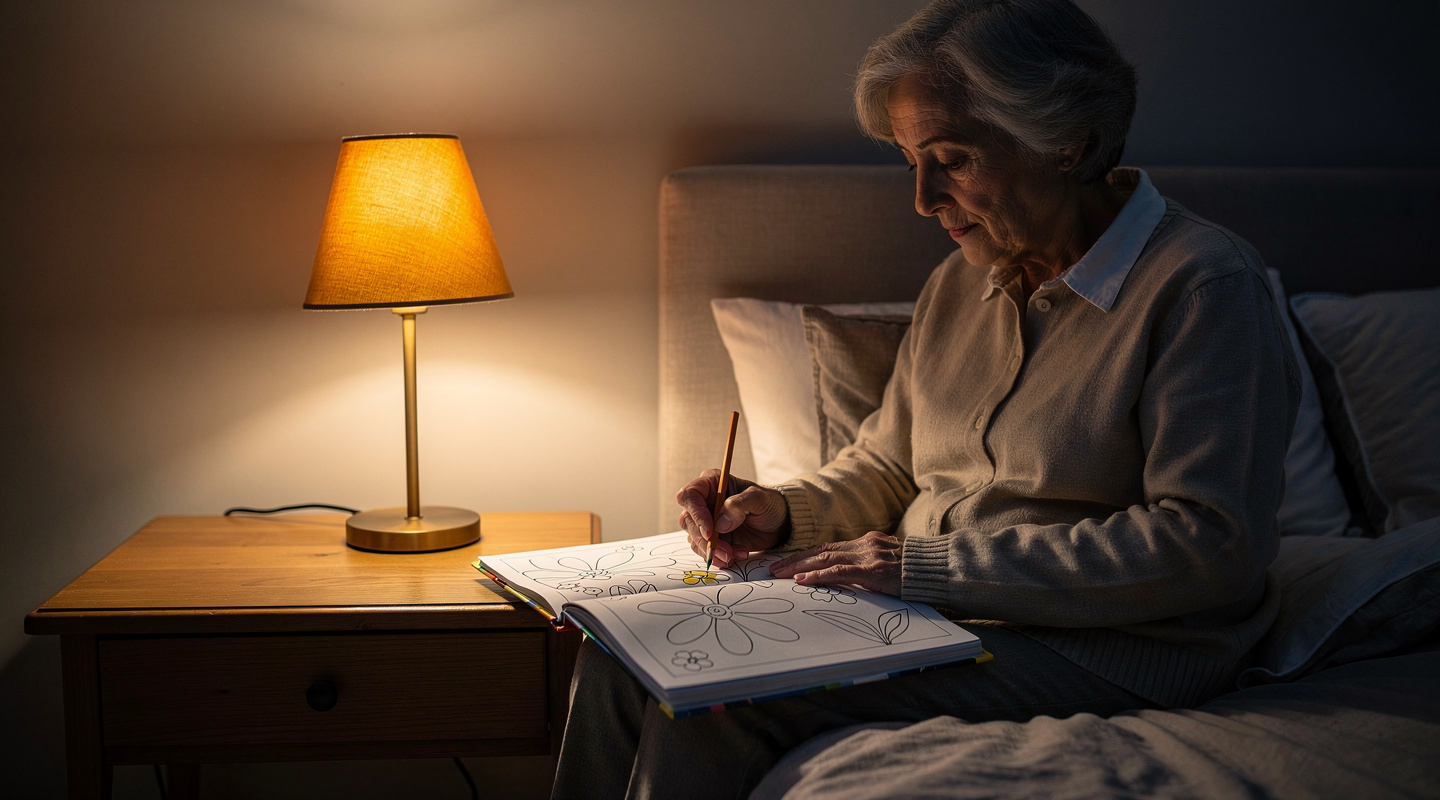
With paper and colored pencils, there’s no light source aimed at your eyes. A soft bedside lamp is all you need — and your body’s natural shift toward sleep can happen without interference. - It gently draws your mind into the present moment
When you color, your attention naturally narrows to the motion of the pencil, the choice of color, the small area of paper in front of you. Worries and mental chatter don’t disappear entirely, but they tend to fade to the background. This focused-yet-relaxed state is close to what mindfulness practitioners describe — and it activates the parasympathetic nervous system, the body’s “rest and recover” mode. - You don’t have to finish — so it’s easy to keep doing
A book has chapters; a puzzle has a shape it wants to be. Coloring asks nothing of you. You can put it down mid-flower, mid-leaf, mid-anything, and pick it up again whenever you like. That freedom from pressure makes it unusually easy to maintain as a habit.
These three qualities together make coloring one of the more practical and low-effort ways to wind down before bed. The bar couldn’t be lower: just choose a color and start.
Yuki
Shio
Choosing the Right Kind of Line Drawing for Nighttime
Not all coloring pages are created equal — and the type you choose in the evening matters more than you might think.
For nighttime coloring, look for images with clean, simple lines and generous open areas to fill in. Flowers and botanical motifs with a relaxed, spacious layout work wonderfully, as do patterns built on gentle repetition — leaves, waves, simple geometric shapes. As you fill in these designs, a soothing rhythm develops almost on its own, and the act of coloring becomes quietly meditative.
Complex pages with dense fine detail, or designs requiring many different colors and careful decision-making, are better suited to a focused afternoon session. At night, simpler is better. The goal isn’t achievement — it’s ease.
Color choice matters, too. Sticking to a limited palette, or leaning toward cool, calming shades like blues and greens, tends to keep visual stimulation gentle. Some people find that restricting themselves to just three or four colors for an evening session creates a surprising sense of calm. Give it a try and see what feels right to you.
Try It Tonight — A Simple 15-Minute Coloring Routine
If “every night” sounds like a commitment that might not stick, don’t start there. Start with fifteen minutes, and just see how it feels.
Here’s one way it might look: after dinner and your bath, turn off the television. Move to wherever you find most comfortable — a favorite chair, or your bed — and switch on a warm lamp. Set out a few pencils and open your coloring page. Color quietly for about fifteen minutes. Then close everything up and settle in for sleep.
Do this consistently, and something interesting tends to happen over time: your body begins to associate the act of coloring with falling asleep. It becomes a cue — almost like a gentle signal that says, “this is how we wind down now.” Sleep researchers call this kind of pre-sleep sequence a “sleep ritual,” and there’s solid evidence that it helps the brain transition more smoothly into rest.
“I’d been struggling to sleep for months, and once I started coloring before bed, I found myself getting drowsy naturally” — this kind of experience comes up again and again among people who’ve tried it. It may be worth fifteen minutes of your evening to find out if it works for you too.

You Don’t Need Much. How to Put Together a Simple Nighttime Coloring Kit
Getting started doesn’t require a trip to the art supply store or a significant investment. For evening coloring, the basics are genuinely enough.
You need something to color in — this can be a printed line drawing from a phone or tablet app, or a coloring book from a bookstore. Adult coloring books have become widely available, and many are designed with exactly this kind of relaxed use in mind. For tools, a set of 10 to 12 colored pencils is plenty for an evening session. If you prefer markers, water-based ones are a gentler choice for use in the bedroom, as they tend to have less scent.
A small tray or pouch to keep your pencils in makes a real difference — not just for tidiness, but because having everything ready in one place removes the friction of getting started. Keep your kit somewhere visible and within easy reach: a nightstand, a side table next to your favorite chair. When the things you need are right there, you’re far more likely to actually use them.

Yuki
Shio
Find Tonight’s Line Drawing on IROTSUNA
If you’re not sure where to find coloring pages, or printing feels like too much of a step, IROTSUNA is here to help. IROTSUNA is a coloring app designed with seniors in mind — people in their 60s and 70s who want a calming, social creative outlet.
Inside the app, you’ll find a wide selection of line drawings well suited to evening use: simple floral and nature motifs, gentle repeating patterns, and designs that invite you to settle in rather than concentrate hard. You can also share what you’ve made with other users, and browse the work of people across the community. For many users, that sense of connection — “I’ll show this to someone tomorrow” — is part of what makes the habit stick.
Tonight, consider setting down the phone and picking up some colored pencils instead. Just fifteen minutes. It might be the small shift that makes a real difference to your sleep. Download IROTSUNA free on the App Store.