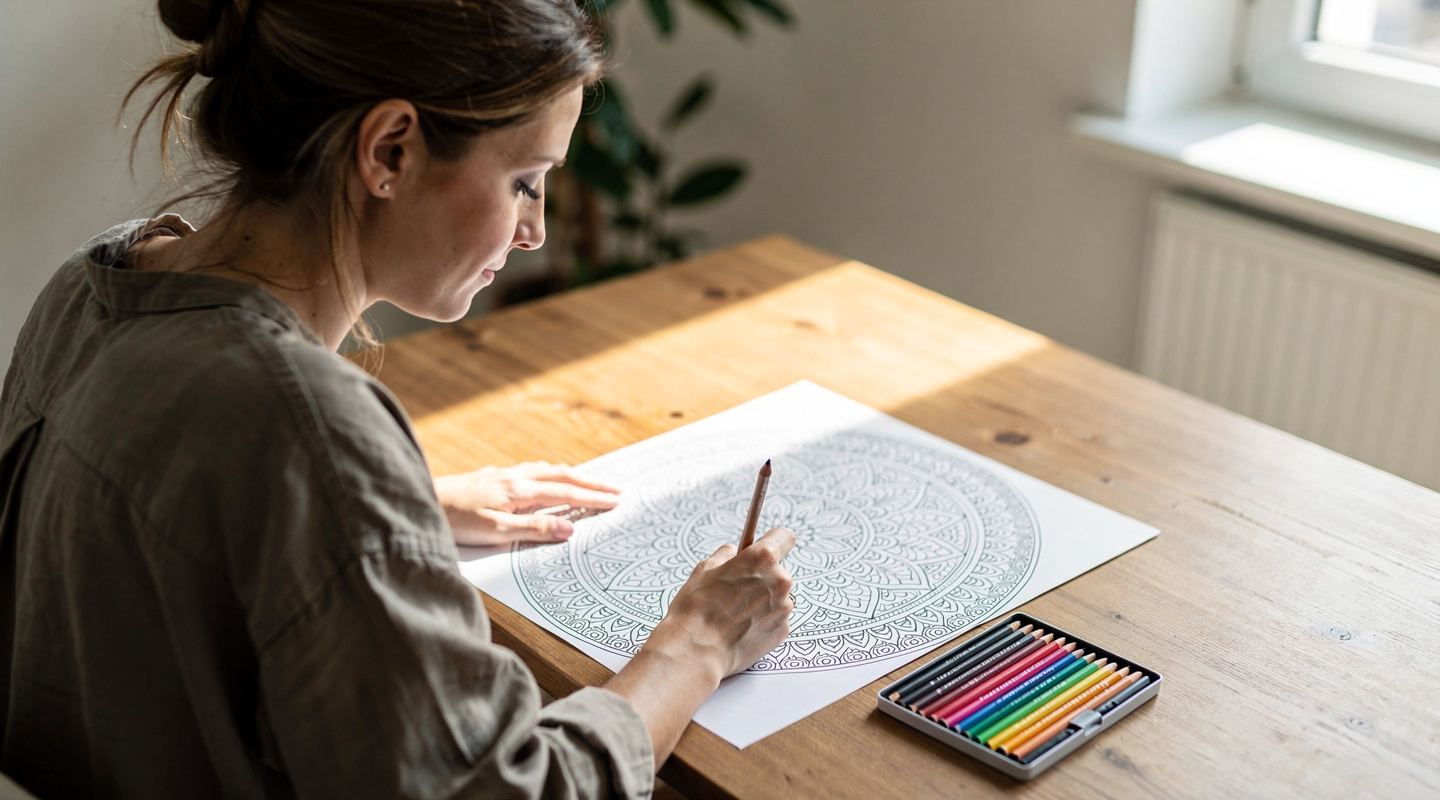
The Real Effects of Coloring Pages: Stress, Focus, and Sleep — What Science Actually Says
Here’s something nobody tells you about coloring pages: they’ve been quietly studied in university labs, and the results are more interesting than you’d expect.
Not “mindfulness app” interesting. Actually interesting. Multiple studies have looked at what happens to your brain, your stress hormones, and your sleep patterns when you pick up a colored pencil and start filling in shapes. This article covers what the research actually says — and what it doesn’t.

Yuki

Shio
Does Coloring Actually Work? The Short Answer
Yes. With some caveats. The research isn’t perfect, and nobody’s claiming coloring cures anything. But there’s a reasonable body of evidence showing it produces measurable changes in stress hormones, anxiety levels, and mood — in people with and without any artistic background.
Two core mechanisms seem to explain most of the benefits. First: focused attention on a low-stakes task pulls the brain’s processing resources away from rumination and worry. Second: the repetitive rhythmic motion involved in coloring triggers serotonin release — the same neurochemical mechanism behind the calming effect of walking or swimming.
When these two things happen at once, the downstream effects — stress reduction, improved focus, better sleep — start to make sense. Not magic. Just neuroscience, kind of.
Effect 1: Stress Relief — Your Brain Finds the Present Moment
When you color, your brain is doing something specific: managing color choices, tracking line boundaries, watching a blank shape become something. That’s just enough mental load to crowd out the usual background noise — unfinished conversations, tomorrow’s tasks, yesterday’s regrets.
Researchers at Drexel University put this to the test. In a study of 39 adults who spent 45 minutes making art, about 75% showed measurable decreases in cortisol — the body’s primary stress hormone. Prior artistic experience made no difference. The people who “can’t draw” benefited just as much as the ones who could.
📄 Source: At Any Skill Level, Making Art Reduces Stress Hormones — Drexel University (2016)
Clinical psychologist Scott M. Bea, PsyD at Cleveland Clinic describes coloring as “very much like a meditative exercise.” When you’re focused on placing color inside a shape, you’re not disturbed by your own thoughts. Life’s challenges recede. And the calm doesn’t necessarily disappear the moment you put down the pencil.
📄 Source: 3 Reasons Adult Coloring Can Actually Relax Your Brain — Cleveland Clinic
📌 Key Takeaways
- Coloring reduces cortisol levels in approximately 75% of participants, regardless of skill level
- Focused attention on a simple task crowds out rumination and anxious thought
- The calming effect often persists after the session ends
→ For a deeper dive into the stress-relief science, see Why Coloring Is a Powerful Stress Reliever — The Science Behind It.
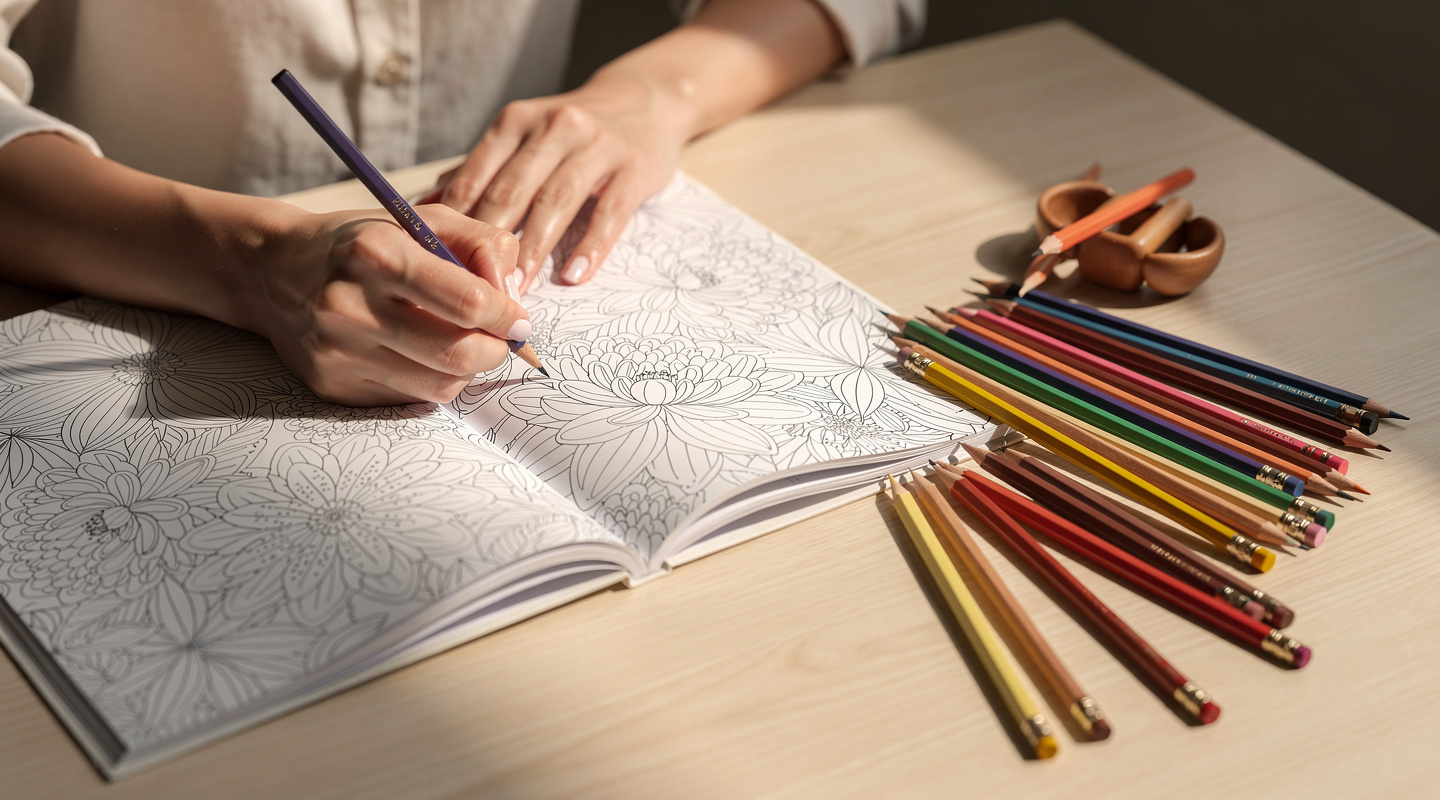
Effect 2: Improved Focus — Your Brain Switches Gears
Ever finish work and find your brain still running the same anxious loops? The laptop’s closed but your head hasn’t actually logged off.
Coloring interrupts that. Not by forcing relaxation — by replacing one type of mental engagement with another. The act of choosing colors, tracking forms, making small decisions about shading: this activates the prefrontal cortex in a way that’s different enough from your usual stressors to function as a genuine cognitive reset.
This is related to what psychologists call “flow” — the state of being absorbed enough in an activity that time passes unnoticed. Coloring occupies that sweet spot: complex enough to require attention, simple enough not to produce its own anxiety. When you exit that state, the cognitive residue of your previous stress is often reduced or gone.
→ Want the full picture on coloring and concentration? Read Sharpen Your Focus with Coloring — 15 Minutes of Brain Exercise a Day.
Effect 3: Better Sleep — The Nighttime Coloring Ritual
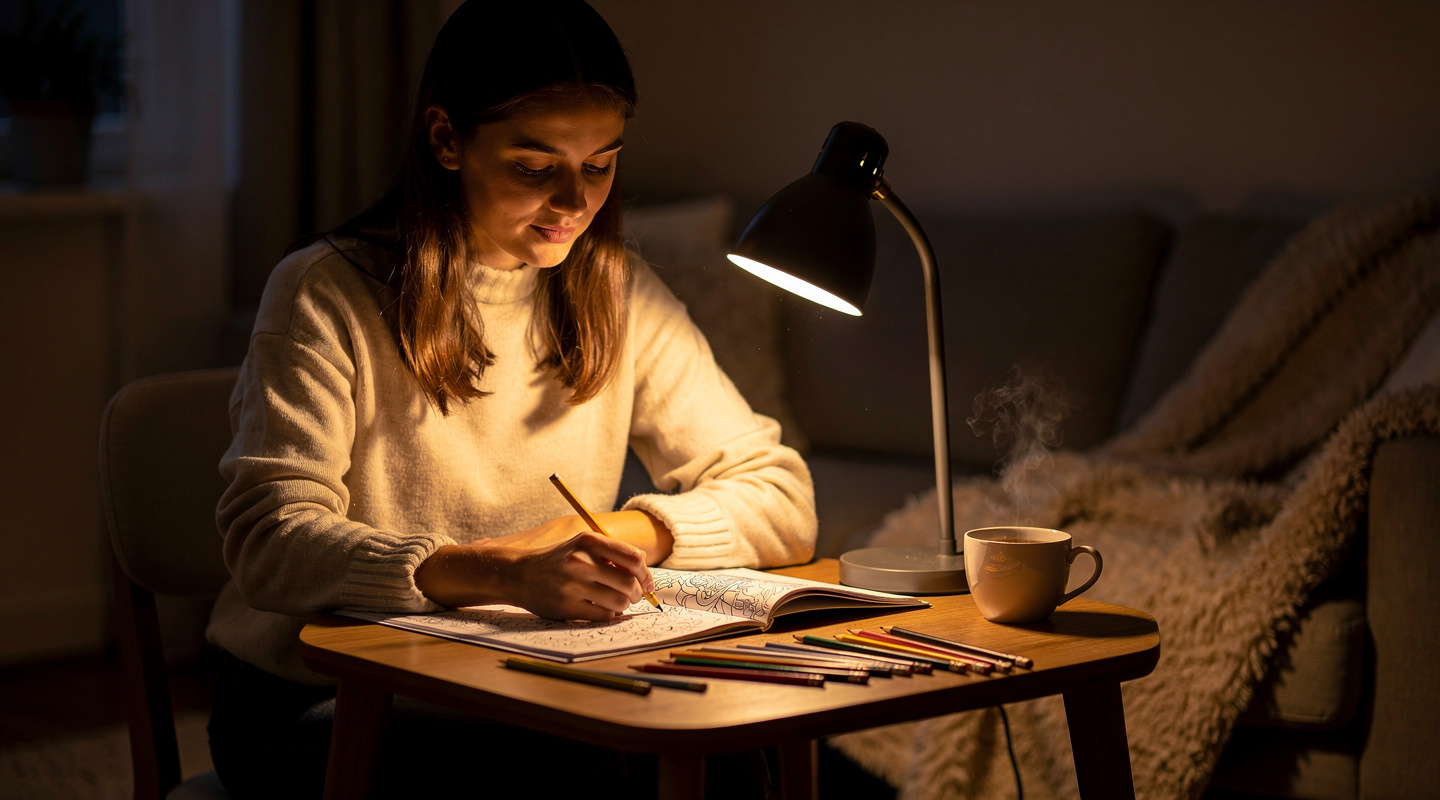
What are you doing in the hour before bed? If it involves a phone or tablet, your sleep is probably taking a hit. Screen brightness and blue-spectrum light can suppress melatonin production — the hormone that signals your body it’s time to sleep. The content doesn’t even have to be stressful. The light alone is enough to push your sleep window later.
Coloring is a screen-free activity that does the opposite. Done under a warm lamp, it signals wind-down. The low cognitive load, the repetitive hand movement, the absence of notifications: together, these help shift your nervous system from sympathetic mode (alert, reactive) to parasympathetic mode (calm, restorative). People who’ve tried it often report falling asleep more easily — not because they forced it, but because the transition happened naturally.
I know, I know — sleep problems are complicated and one habit doesn’t fix everything. But replacing late-night scrolling with thirty minutes of coloring is a low-risk substitution worth trying.
📌 Key Takeaways
- Screen brightness before bed suppresses melatonin and delays sleep onset
- Coloring is screen-free and supports the parasympathetic (rest) nervous system
- A consistent pre-bed coloring routine may improve sleep quality over time
→ The full breakdown on coloring and sleep is here: Coloring Before Bed: Why It Helps You Sleep Better.
Yuki
Shio
Effect 4: Mood Improvement — What “Finished” Does to Your Brain
When you complete a task, any task, your brain releases dopamine. This is the reward signal — associated with motivation, pleasure, and the feeling of forward momentum. We usually associate it with major accomplishments. But the brain doesn’t actually make that distinction.
Finishing a coloring page is a completion. A real one. You started something, you followed through, and now there’s a finished object that didn’t exist before. That registers. The dopamine release is modest, but it’s real — and it accumulates when you make it a habit.
A randomized controlled study found that participants who completed a mandala coloring activity for 20 minutes showed significantly lower anxiety levels compared to the control group. They also reported feeling calmer, more at ease, and more satisfied. The mandala-specific format appeared particularly effective, though the broader mechanism — completion, focused attention, creative engagement — applies to coloring in general.
📄 Source: Coloring Activities for Anxiety Reduction and Mood Improvement — PMC (Koo et al., 2020)
Newer research also suggests that creative activities engage the medial prefrontal cortex and amygdala simultaneously — regions central to emotional regulation. Which means coloring might not just distract you from negative feelings, but actively support the neural pathways involved in processing them.
How Long Before You Feel Something?
This sounds obvious. It isn’t.
Most people assume benefits require weeks of consistent practice before showing up. For coloring, the timeline is shorter. Researcher Girija Kaimal has noted that stress changes can begin within 15 minutes — making this one of the faster-acting non-pharmaceutical mood interventions available.
📄 Source: New Research Shows A Few Minutes of Coloring Can Erase Your Stress — Time (2026)
That said, the compounding effects — better baseline mood, improved sleep patterns, a sense of creative identity — take longer. Most people notice something meaningful after a week of 15–20 minute daily sessions. The first finished page creates momentum. The tenth creates a habit.
Difficulty level matters too. Aim for pages that are engaging but not frustrating — complex enough to hold your attention, simple enough that you’re not fighting the page. That sweet spot is where flow happens, which is where the real benefits are.
📌 Key Takeaways
- Stress reduction can begin within 15 minutes of starting
- Bigger benefits — sleep, mood baseline, habit — build over days and weeks
- Choose pages that engage without frustrating — that’s where the flow state lives
Start Today with IROTSUNA
The hardest part of coloring isn’t the coloring. It’s finding a page that makes you want to start.
IROTSUNA is a free app that generates custom line art from whatever you type. Describe an image — a quiet mountain lake, a detailed flower pattern, a geometric mandala — and an AI creates a unique coloring page in about 30 seconds. You can color it digitally or print it and use real pencils. Both work.
When you’re done, you can share your finished page in the in-app gallery, where other users post their work and leave comments. The stress relief of coloring, plus the small pleasure of someone noticing what you made.
Download free on the App Store. And honestly? That’s enough.